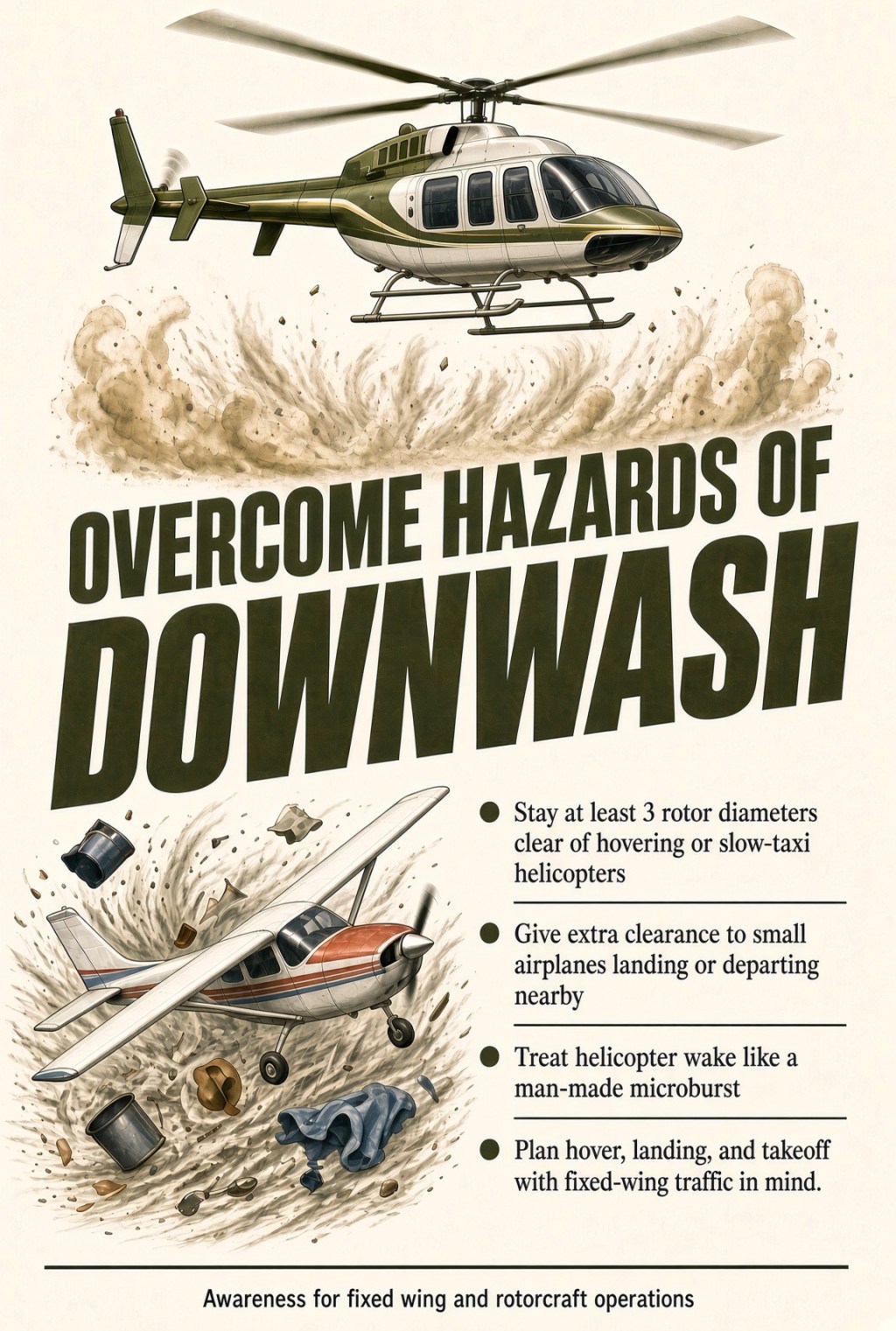
Some of the most dangerous wake turbulence at an airport may come from an aircraft you were never taught to worry about.
A helicopter.
At Wadsworth Municipal Airport in Ohio in 2021, a RANS S-20 was holding short of Runway 2 while a Sikorsky S-76 helicopter landed on the runway. After the helicopter passed, the RANS taxied onto the runway and began its takeoff roll. Shortly after liftoff, the airplane entered a steep roll and struck the runway. The pilot was killed.
The NTSB determined that the airplane encountered wake turbulence from the helicopter. What may surprise many pilots is just how much wake turbulence a helicopter can create. Helicopter wake may be one of the most overlooked hazards in general aviation.
Helicopters can generate wake turbulence powerful enough to upset a light airplane, yet the subject receives relatively little attention in traditional airplane training. A pilot can learn the familiar rules for avoiding wake behind larger airplanes without ever developing the same awareness around helicopters.
What We Learn About Wake Turbulence
Most of us are introduced to wake turbulence early in our training. The discussion usually centers on larger airplanes: where their vortices form, how they sink and drift, and how to avoid them during takeoff and landing.
And that isn’t necessarily the last time we hear it presented that way. Wake turbulence comes up again during flight reviews, aircraft transitions, additional ratings and advanced training. The airplanes may get bigger and the training more sophisticated, but the familiar examples often remain much the same. We talk about following a heavy aircraft, crossing behind another airplane’s flight path, or allowing additional time before departing. Helicopters receive little more than a passing mention, if they are discussed at all.
The result isn’t that pilots haven’t been taught about wake turbulence. Most have, repeatedly. The gap is that many may never have been given the same awareness of what a helicopter can do to disrupt the air around them. That is particularly important at airports where light airplanes and helicopters routinely operate together.
A Different Kind of Wake
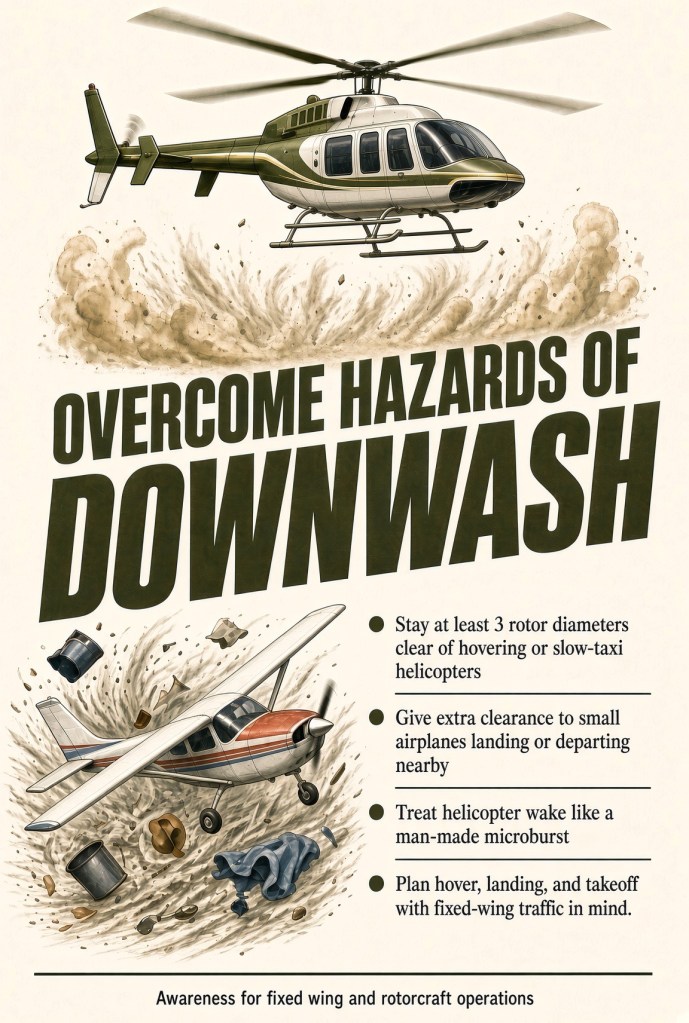
Helicopter wake doesn’t always fit the familiar picture of wake turbulence because the rotor system affects the air differently during different phases of flight. In a hover or slow hover taxi, the rotor system moves a tremendous volume of air downward and outward. The FAA recommends that small aircraft avoid operating within three rotor diameters of a helicopter in a stationary hover or slow hover taxi. That can represent a surprisingly large area around the helicopter, particularly for a light airplane taxiing or operating nearby. Once a helicopter is in forward flight, it also produces trailing wake vortices. Those vortices can remain after the helicopter has moved on and, like airplane wake, can be affected by wind.
The FAA put additional emphasis on the hazard in AC 90-23H, its updated wake-vortex guidance issued in January 2026. For wake avoidance, the FAA encourages airplane pilots to give a helicopter more separation than they would an airplane of comparable size. That is an important distinction. A helicopter that appears relatively small from the cockpit of an airplane can create a wake hazard much greater than its size might suggest.
When the Familiar Rules Aren’t Enough
The 2014 accident at Fort Collins-Loveland Municipal Airport in Colorado shows how difficult that wake can be to judge even when a pilot recognizes the hazard.
A student pilot in a Cirrus SR20 was returning from a solo instructional flight while a UH-60 Black Hawk helicopter was operating in the traffic pattern. The student was aware of the helicopter and concerned about its wake turbulence. He delayed his turn to base and planned his approach so he could land beyond the helicopter’s touchdown point. Then the Black Hawk departed.
About 30 seconds later, the Cirrus was approaching the runway when it encountered turbulent air and rolled sharply to the left. The student attempted to correct the bank and initiate a go-around, but the airplane struck the ground and cartwheeled. He was seriously injured.
The NTSB determined that the student failed to comprehend the significance of the wake turbulence generated by the departing helicopter. The accident is especially noteworthy because the student did recognize wake turbulence as a potential hazard. He made adjustments to avoid it, using techniques that would be familiar to many airplane pilots. His experience demonstrates that recognizing helicopter wake as a hazard and understanding its strength and persistence are not necessarily the same thing.
A Different Picture of Wake Turbulence
None of this suggests that airplane pilots need an in-depth understanding of helicopter aerodynamics. But we may need to expand the picture that comes to mind when we hear the words wake turbulence.
Perhaps the bigger challenge is awareness. Helicopters and airplanes share airports safely every day. They share runways, taxiways, traffic patterns and increasingly busy training environments. Yet two pilots using the same airport may have been taught very different things about what happens to the air when a helicopter operates nearby.
Wake turbulence has never been only a large-airplane problem. For many airplane pilots, however, that is still how we learned to think about it. The next time a helicopter is operating nearby, seeing the aircraft is only part of the picture. The air around it deserves our attention too.


Leave a comment