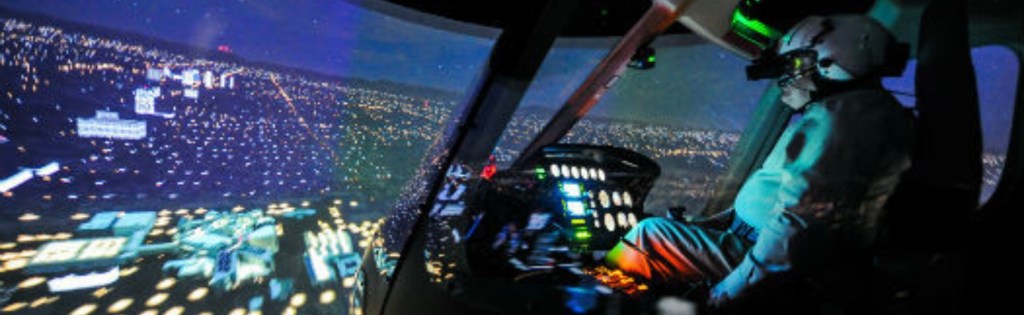
It has taken almost a decade for scenario-based simulator training to be made available to the majority of commercial helicopter operators, but today there is a wide range of helicopter simulator options available and more on the way. Many operators can take advantage of simulator training to improve their operational safety.
People often ask what different types of simulators are available and how much training credit is accepted by the regulatory agencies when training in a simulator. As more simulators are becoming available, there is more pressure to use simulation for at least a portion of the training. Here is a brief explanation of the type of simulators that also provide approved training credit by most regulators.
There are two categories of devices recognized by most regulating agencies to provide flight simulation training. A flight training device (FTD) is a non-motion trainer that replicates a specific aircraft, including instruments, equipment, panels, and controls, in an open or closed flight deck.
A full flight simulator (FFS) is the most advanced type of flight simulation available to pilots and training institutions. An FFS has a motion base and includes a full replica of a specific make, model, and series of the aircraft cockpit. All aerodynamics, flight controls, and systems must perform as the actual aircraft would in flight.
In each case, as the simulators go up in complexity, they provide a more realistic training environment in terms of the flight systems, visual display, motion simulator, and cockpit environment. The highest level, FFS Level D, provides a motion platform capable of moving in all six degrees, a visual system with a view of 180 degrees, and a number of special motion, visual, and aural effects to provide a realistic cockpit environment. The FFS Level C has the same motion and visual capability with less visual and aural effects. The FFS Level B has at least a three-axis motion platform and a visual system that responds to the pilot input at a slower rate than the level C or D.
Aircraft specific Flight Training Devices are designated by numbers rather than the letters that correspond to Full Flight Simulators. The highest level, FTD Level 7 has an enclosed flight deck and a fully operational aerodynamic program with all helicopter systems operational. All controls and switches replicate the feel of the aircraft. The visual system must provide cross-deck viewing from both pilots’ seats and vibration cues enhance the realism of the training. FTD Level 6 is the same as Level 7 without the vibration cues. FTD Level 5 has at least one operating system and the flight controls must be physical controls. FTD Level 4 has one operating system.
Many pilots and operators have questions in regard to the training credit allocated in different devices. The final decision as to the amount of training credit for commercial operators is often the decision of their regulator. In general, however, the more complex simulators receive the higher amounts of training credits.
For example, almost everyone gets 100 percent training credit for work done in a Level D FFS, which is used by airline operations and many corporate fixed-wing operations. This level of simulator is also the most expensive. Credit obtained for training in a Level B or C FFS depends on the equipment capability and the decision of the regulator.
Another factor in choosing your simulator is cost. In general, the more complex simulators are more expensive. This is why it’s important to review your budget and think about what you want to get out of the simulator training. For example, there is a significant difference in the operating costs of a Level D FFS and a Level 7 FTD. It can be very cost-effective for an operator of single-engine aircraft such as Airbus Helicopters AS350 and the Bell 206 and 407 to use the Level 7 FTD. Training credit for a Level 7 has been equal or better than a Level B full-motion simulator and costs a lot less to use.
The latest technical advances in simulator visual systems provide a very realistic training environment. There are a number of Level 7 FTDs for single-engine helicopter training, and training credit ranges between 80 and 95 percent, depending on the operator and the inspector.
A Level 6 FTD gets a slightly lower training credit as it usually does not have a seat shaker or vibration in the simulation. Anything below a Level 6 will definitely have training value; however, FAA training credit varies significantly.
Some pilots have expressed concerns about receiving anything less than 100 percent of the training credit. However, if you consider that most operations require some sort of local-area orientation flights, the difference can easily be made up in the aircraft at minimal cost.
There is no one-size-fits-all answer to simulator training. But there is an answer that will fit most operations and budgets — and, as the NTSB has stated, “Consistent, standardized simulator training will help prepare pilots for the unexpected and will decrease the risk of an accident.”
To get the most out of your investment in simulator training, develop specific goals for the training that match your operational challenges. Then research the most cost-effective means to meet those goals. There are many resources to help you get started in building an effective simulator training program — and eventually a safer flight operation.


Leave a comment